Halogenfreie flammhemmende Kabel verwenden häufig Aluminiumtrihydroxid (ATH) und Magnesiumdihydroxid (MDH) als Füllstoffe. Diese anorganischen Pulver weisen eine hohe Oberflächenpolarität und eine schlechte Kompatibilität mit Polyolefin-Matrizen auf, was zu Agglomeration sowie verringerten mechanischen Eigenschaften und Flammhemmung führt. Silan-Kopplungsreagenzien werden häufig eingesetzt, um dieses Problem zu lösen.
ECOPOWERs Crosile®-173 (Vinyltriisopropoxysilan)zeichnet sich bei der Behandlung ultrafeiner Pulver und bei hochwertigen Kabelcompounds aufgrund seines einzigartigen Hydrolyseverhaltens aus.
Molekülstruktur und Hydrolyseeigenschaften
Crosile®-173 enthält drei Isopropoxygruppen, die eine größere sterische Hinderung als Methoxygruppen (z. B. Crosile®-171) oder Ethoxygruppen (z. B. Crosile®-151) aufweisen. Dies führt in Gegenwart von Wasser zu einer langsameren Hydrolyserate. Für die Oberflächenbehandlung von Füllstoffen bietet eine langsame Hydrolyse folgende Vorteile:
- Längere Topfzeit und geringeres Risiko einer vorzeitigen Kondensation;
- Ausreichend Zeit für Silanmoleküle, sich gleichmäßig auf der Füllstoffoberfläche zu verteilen und eine Monoschichtbeschichtung zu bilden;
- Geeignetheit für ultrafeine Pulver mit hoher spezifischer Oberfläche (z. B. MDH mit einer Partikelgröße
Schlüsselfunktionen in Kabelcompounds
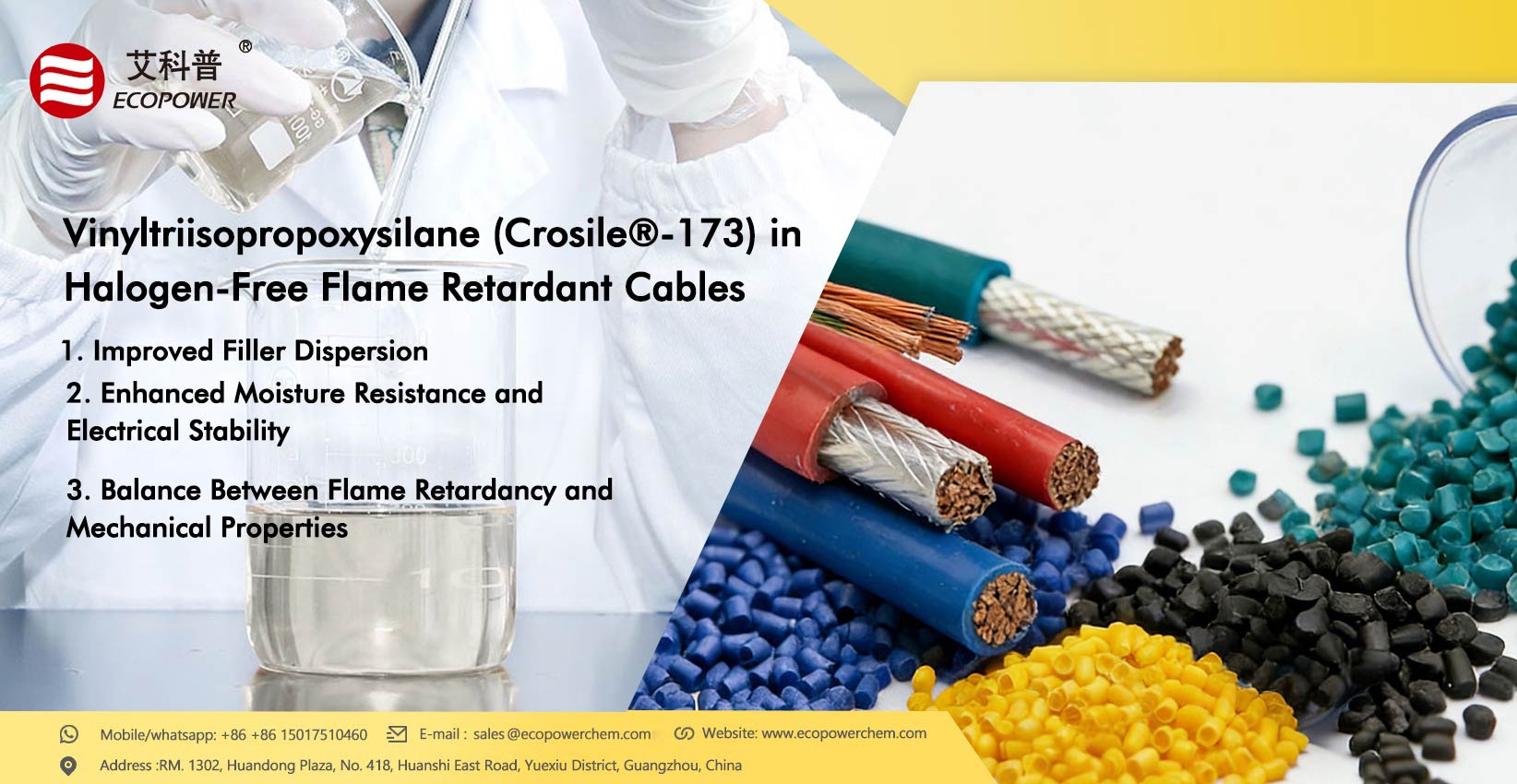
1. Verbesserte Füllstoffdispersion
Nach der Behandlung mit Crosile®-173 wird die Füllstoffoberfläche hydrophob, wodurch die Benetzbarkeit mit dem Harz verbessert wird. Die Agglomeration während des Compoundierens wird reduziert, was zu einer gleichmäßigen Dispersion, glatteren Produktoberflächen und einer stabileren Extrusion führt.
2. Verbesserte Feuchtigkeitsbeständigkeit und elektrische Stabilität
Das Silan bildet chemische Bindungen an der Grenzfläche zwischen Füllstoff und Harz und erzeugt eine feste Verbindung. In feuchten Umgebungen wird das Eindringen von Wasser entlang der Grenzfläche behindert, wodurch der Abfall des Isolationswiderstands verzögert wird. Feuchtigkeitsalterungstests zeigen, dass mit Crosile®-173 behandelte Kabel nach längerer Wasserexposition einen höheren Volumenwiderstand beibehalten.
3. Ausgewogenes Verhältnis zwischen Flammhemmung und mechanischen Eigenschaften
Bei hohen Füllstoffgehalten sind Grenzflächendefekte die Hauptursache für Versprödung. Die Kopplungswirkung von Crosile®-173 ermöglicht es dem Füllstoff, eine gewisse Verstärkung beizutragen, wodurch der Verlust an Zugfestigkeit und Bruchdehnung minimiert wird. Gleichzeitig fördern gut dispergierte Füllstoffe während der Verbrennung die Bildung einer kontinuierlichen Kohleschicht und verbessern dadurch die Flammhemmung.
Vergleich mit gängigen Vinylsilanen
| Silan-Typ |
Hydrolysierbare Gruppe |
Hydrolyserate |
Typische Anwendungen |
| Crosile®-151 |
Triethoxy Mittel |
Schnell |
Allgemeine Füllstoffe, moderate Feuchtigkeitskontrolle |
| Crosile®-171 |
Trimethoxy |
Schnell |
Systeme, die eine schnelle Reaktion erfordern |
| Crosile®-172 |
Methoxyethoxy |
Mittel |
Zwischenlösung zwischen 151 und 173 |
| Crosile®-173 |
Triisopropoxy |
Langsam |
Ultrafeine Füllstoffe, Systeme mit Anforderungen an Gleichmäßigkeit |
Bei der Modifizierung ultrafeiner Füllstoffe, der Herstellung aktiver Flammschutzmittel oder Prozessen, die längere Verarbeitungsfenster erfordern, sorgt die langsame Hydrolyse von Crosile®-173 für konsistentere Ergebnisse.
Anwendungsrichtlinien
- Direkte Zugabe: Fügen Sie das Silan zusammen mit anderen Additiven während der Compoundierung hinzu. Stellen Sie eine ausreichende Temperatur und Feuchtigkeit sicher (oder verwenden Sie einen Katalysator), um die Reaktion zu fördern.
- Vorbehandlung: Verdünnen Sie das Silan mit einer Alkohol-/Wasserlösung (schwach saure Bedingungen können die Hydrolyse beschleunigen). Sprühen Sie es unter Hochgeschwindigkeitsmischung auf den Füllstoff und trocknen Sie ihn anschließend. Diese Methode eignet sich zur Herstellung aktiver Flammschutzpulver.
Erweiterte Anwendungen
Über Kabelmaterialien hinaus wird Crosile®-173 auch verwendet in:
- Silanvernetztes Polyethylen: als Vernetzer für hitzebeständige Rohre und Kabelisolierungen;
- Silikon-Acryl-Emulsionen: Aufgrund seiner Hydrolysestabilität ist das Emulsionssystem weniger anfällig für Gelierung und eignet sich für Hochleistungs-Außenbeschichtungen.
Vinyltriisopropoxysilan (Crosile®-173) löst durch seine langsame, kontrollierte Hydrolyse die Herausforderungen bei Dispersion und Grenzflächen in hochgefüllten Systemen mit ultrafeinen anorganischen Flammschutzfüllstoffen. Für hochwertige Kabelcompounds, die langfristige Zuverlässigkeit und Verarbeitungsstabilität erfordern, ist es ein funktionelles Additiv, das in Betracht gezogen werden sollte.
 Whatsapp us